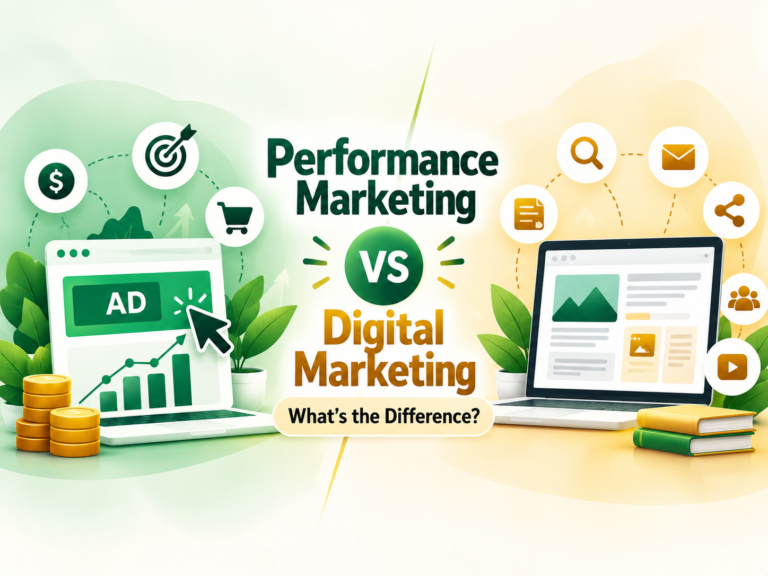

A restaurant owner once described her marketing budget to us like this: “I spend $2,000 a month and I have no idea what it’s actually doing.” She wasn’t wrong to be confused. She’d been told her Google Ads campaign was “performance marketing,” her billboard was “brand marketing,” and nobody had explained why that distinction mattered — or why one of those two things could tell her exactly how many customers it brought in, and the other couldn’t.
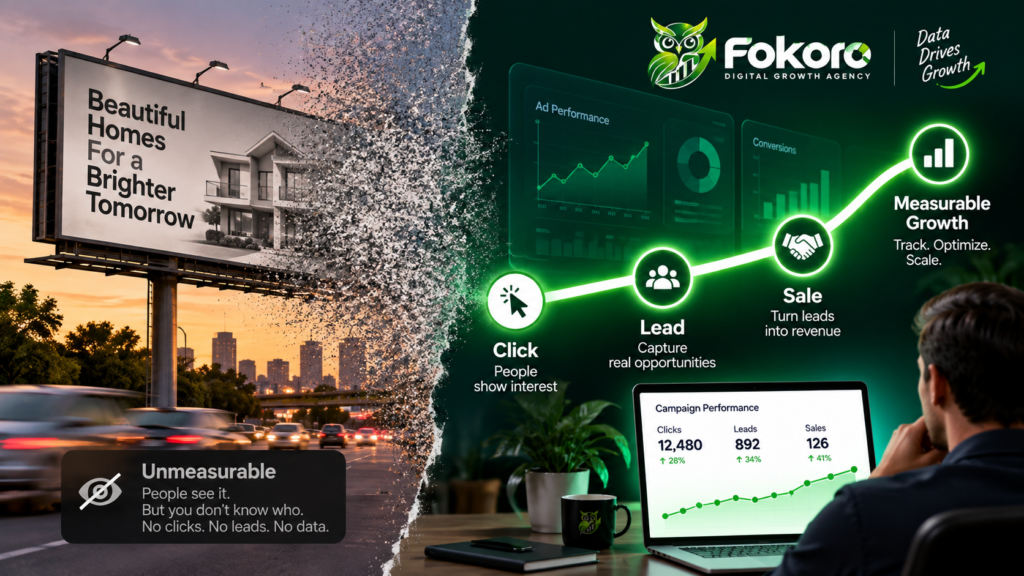
That distinction is the entire point of performance marketing. It isn’t a specific channel or a single tactic. It’s a way of buying marketing where you only pay for a defined, measurable outcome — a click, a lead, a sale, an install — rather than paying for exposure and hoping it converts.
This article breaks down what that actually means in practice, how the mechanics work behind the scenes, which channels fall under the performance marketing umbrella, and where the model runs into real limitations.
The core definition
Performance marketing is digital advertising in which the advertiser pays based on specific, trackable actions rather than on impressions or airtime alone.
Compare that to traditional marketing: a TV spot, a print ad, a billboard. You pay a fixed price for the audience’s attention, and you generally can’t tie a specific sale back to a specific viewing of that ad. Performance marketing flips that. The cost is tied to an action the platform can actually record — someone clicked, someone filled out a form, someone completed a purchase — and in many models, you don’t pay at all unless that action happens.
That single mechanical difference — payment tied to a measurable event instead of payment for exposure — is what separates performance marketing from brand marketing, even when both are running on the same digital platforms.
How the payment models actually work
This is the part most explanations skip, and it’s where the confusion usually starts. There are a handful of distinct pricing models under the performance marketing umbrella, and they aren’t interchangeable:
CPC (Cost Per Click) — You pay each time someone clicks your ad, regardless of what they do afterward. This is the model behind most Google Search and Shopping campaigns.
CPA (Cost Per Acquisition) — You pay when someone completes a specific action: a purchase, a signed-up trial, a submitted lead form. This is closer to what most business owners actually mean when they say “performance marketing” — the outcome, not just the click.
CPM (Cost Per Mille/Thousand Impressions) — You pay based on how many times an ad is shown, not on clicks or actions. This one sits closer to traditional advertising in spirit, but it’s still trackable and optimizable in a way a billboard isn’t — which is why some platforms blend CPM bidding with performance-based optimization underneath it.
CPL (Cost Per Lead) — A variant of CPA specific to lead generation, common in B2B and service businesses where the “sale” happens off-platform, in a sales call or consultation.
ROAS (Return on Ad Spend) — Not a payment model exactly, but the metric most performance campaigns are ultimately optimized toward: revenue generated divided by ad spend. A 4x ROAS means $4 in revenue for every $1 spent.
Here’s the mechanic that actually makes this work: platforms like Google and Meta use pixel-based or API-based conversion tracking. A small snippet of code on your website (or an event sent via API) fires when a defined action happens — a purchase confirmation page loads, a form submits — and reports that event back to the ad platform. The platform then has enough data to know which ads, keywords, and audiences are actually producing the outcome you care about, and its bidding algorithm adjusts spend toward what’s working.
Hypothetical example: A home services company sets up conversion tracking on its quote-request form. Over a month, its Google Ads account records 40 form submissions at a total spend of $2,000 — a cost per lead of $50. Without that tracking in place, the business would only know it spent $2,000. With it, they know what that $2,000 actually produced, and they can decide whether $50 per lead is profitable given their close rate and average job value.

The channels that make up performance marketing
Performance marketing isn’t one platform — it’s a category that spans several:
Paid search (PPC) — Google Ads and Microsoft Advertising, where you bid on keywords and pay per click or per conversion. High commercial intent, since people are actively searching.
Paid social — Meta Ads (Facebook/Instagram), LinkedIn Ads, TikTok Ads. Generally interruption-based rather than intent-based; you’re reaching people mid-scroll, not mid-search, so targeting and creative carry more of the weight.
Affiliate marketing — Paying third-party publishers a commission when their referral results in a sale. Purely outcome-based by design.
Programmatic display and retargeting — Automated buying of display ad space, often used to re-engage people who’ve already visited your site, priced on clicks or conversions.
Shopping and marketplace ads — Google Shopping, Amazon Ads — product-level campaigns priced per click, aimed directly at purchase intent.
Each of these channels has different strengths depending on where a customer is in their decision process, which is why most performance marketing strategies blend more than one rather than relying on a single channel.
Performance marketing vs. brand marketing
These aren’t competitors — they’re different tools solving different problems, and conflating them is one of the most common strategic mistakes we see.
| Performance Marketing | Brand Marketing | |
|---|---|---|
| Primary goal | Immediate, measurable action | Long-term awareness and recall |
| Payment basis | Clicks, leads, sales | Impressions, reach, airtime |
| Measurability | Directly trackable to spend | Indirect, harder to attribute |
| Timeframe | Short-to-mid term results | Long-term brand equity |
| Best for | Businesses needing near-term leads/sales | Businesses building category recognition |
A business with strong brand recognition often sees performance campaigns work harder, because people already trust the name when the ad appears. A business with zero brand recognition sometimes struggles to convert cold traffic through performance channels alone — the ad has to do the job of building trust and closing the sale in a single interaction. In practice, mature marketing programs run both: brand marketing builds the audience, and performance marketing captures and measures demand from within it.
Where performance marketing runs into real limits
Being transparent about this matters, because most content selling performance marketing skips it entirely.
Attribution is getting harder, not easier. iOS privacy changes, cookie deprecation, and cross-device browsing mean platforms increasingly rely on modeled data to fill gaps in what they can directly observe. [VERIFY CURRENT SOURCE] for the current state of Google’s and Meta’s modeled conversion policies, since these evolve.
It rewards what’s already trackable. A well-tracked e-commerce checkout is easy to optimize toward. A B2B sale that closes six weeks later over three phone calls is much harder to tie back to the ad that started it — which means performance data can quietly undervalue channels that actually matter, simply because they’re harder to measure.
It can create a short-term bias. Because the whole system is built around measurable, near-term actions, campaigns optimized purely for last-click performance can starve the upper-funnel activity that generates demand in the first place. Some of the best-performing campaigns we’ve seen are ones where a business deliberately protected budget for brand and top-of-funnel work, even though it doesn’t show up cleanly in a ROAS report.
It requires infrastructure to work well. Accurate conversion tracking depends on correctly implemented tags, clean UTM structures, and — ideally — server-side tracking to reduce data loss from browser restrictions. A campaign can look like it’s underperforming when the real problem is that half its conversions were never recorded.
Fokoro’s practical takeaway
Before we’d recommend increasing performance marketing spend for a client, we’d want to see three things in place: conversion tracking that’s actually firing correctly (verified in the platform, not assumed), a clear definition of what a “qualified” lead or sale looks like for that specific business, and a realistic read on customer lifetime value — because a $50 cost-per-lead is either a great deal or a loss, entirely depending on what that lead is worth once it closes. Performance marketing gives you precise numbers. Precise numbers pointed at the wrong goal just help you optimize toward the wrong thing, faster.
FAQ
Is performance marketing the same as digital marketing?
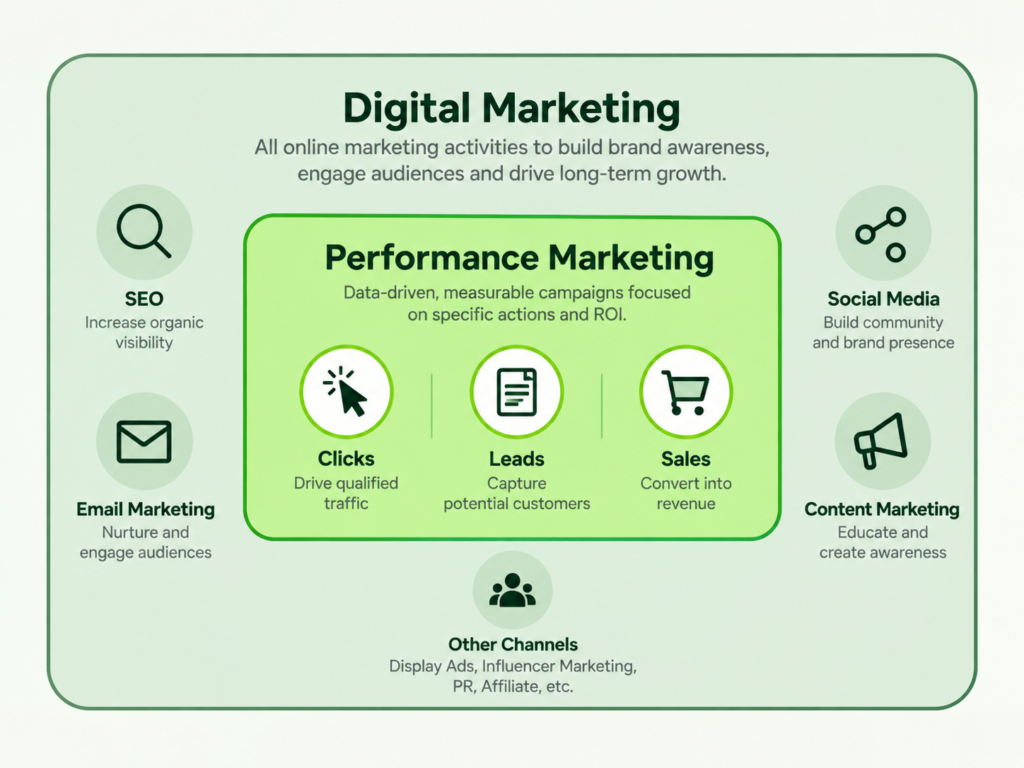
No. Digital marketing is the broader category — it includes SEO, content, email, and brand campaigns online. Performance marketing is a subset defined specifically by pay-for-outcome pricing and direct trackability.
Is SEO a form of performance marketing?
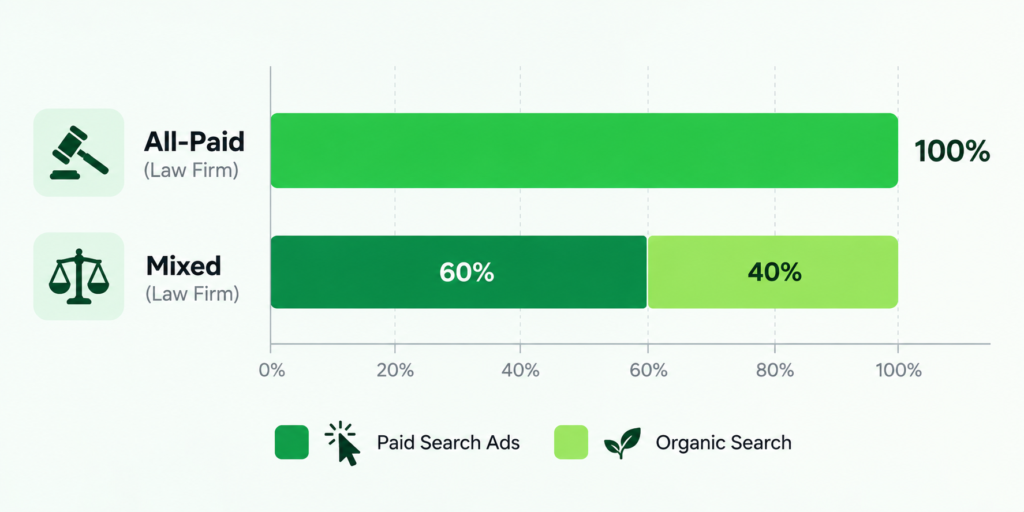
Not in the strict sense, since you don’t pay per click or per conversion for organic search traffic. But SEO is often planned and measured alongside performance marketing because both are demand-capture channels aimed at trackable outcomes.
What’s a good cost per acquisition?
There’s no universal number — it depends entirely on your margins, average order value, and customer lifetime value. A CPA that’s excellent for a $500 service is unworkable for a $15 product.
Do I need a big budget to start with performance marketing?
No, but you need enough budget to generate statistically meaningful data. Extremely small budgets can take longer to produce reliable signal for a platform’s algorithm to optimize against.
Can performance marketing work without a website?
Some of it — lead ads on Meta or LinkedIn can collect information without sending traffic to a website. But most performance channels rely on a landing page or website to convert and track the outcome.
Why do my performance numbers look different in the ad platform than in my analytics tool?
This is common and usually comes down to attribution windows and tracking methodology differing between platforms. [VERIFY CURRENT SOURCE] for each platform’s current attribution settings, since defaults change periodically.
Should a new business start with performance marketing or brand marketing?
Most new businesses need some near-term revenue, so performance marketing is often the practical starting point — but pairing it with even modest brand-building work tends to improve performance results over time, not compete with them.