
A marketing manager once forwarded us two agency proposals for the same monthly budget. One was titled “Digital Marketing Services.” The other was titled “Performance Marketing Program.” Same client industry, similar dollar amount, almost entirely different scope of work. She wanted to know which one was the “real” version.
Neither was wrong. They were just describing different slices of the same larger picture — and the confusion is understandable, because the terms get used loosely enough in the industry that even experienced marketers mix them up. Here’s the actual relationship between them, and why it matters for how you plan a budget.
The short answer
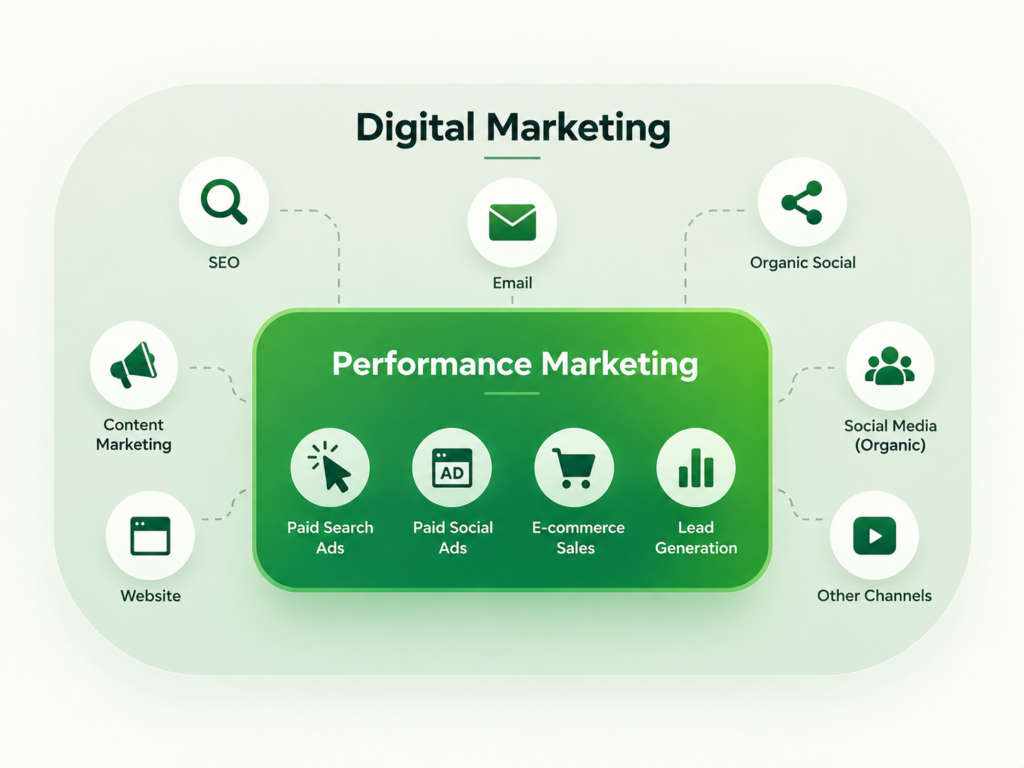
Digital marketing is the entire category. Performance marketing is one part of it.
Digital marketing covers every marketing activity conducted through digital channels — websites, search engines, social media, email, apps — regardless of whether the results are directly trackable or whether you’re paying per outcome. It includes SEO, content marketing, email marketing, organic social, influencer partnerships, and paid advertising, among other things.
Performance marketing is the subset of digital marketing where you pay specifically for a measurable action — a click, a lead, a sale — rather than paying for exposure, reach, or time. It’s defined by its pricing and measurement model, not by which platform it runs on.
So performance marketing is always digital marketing. Digital marketing is only sometimes performance marketing.
Where the two actually diverge
The cleanest way to see the difference is to look at what happens when you stop paying.
With most performance marketing, the moment you pause the campaign, the results stop. A Google Ads campaign generating 30 leads a month produces zero leads the day after you turn it off, because you were essentially renting visibility for as long as you paid for it.
With a lot of digital marketing — SEO being the clearest example — the results tend to persist, or at least decay slowly, after you stop actively investing. A blog post that ranks on page one for a valuable keyword can keep generating traffic for months with minimal ongoing spend, because you built an asset rather than renting a slot.
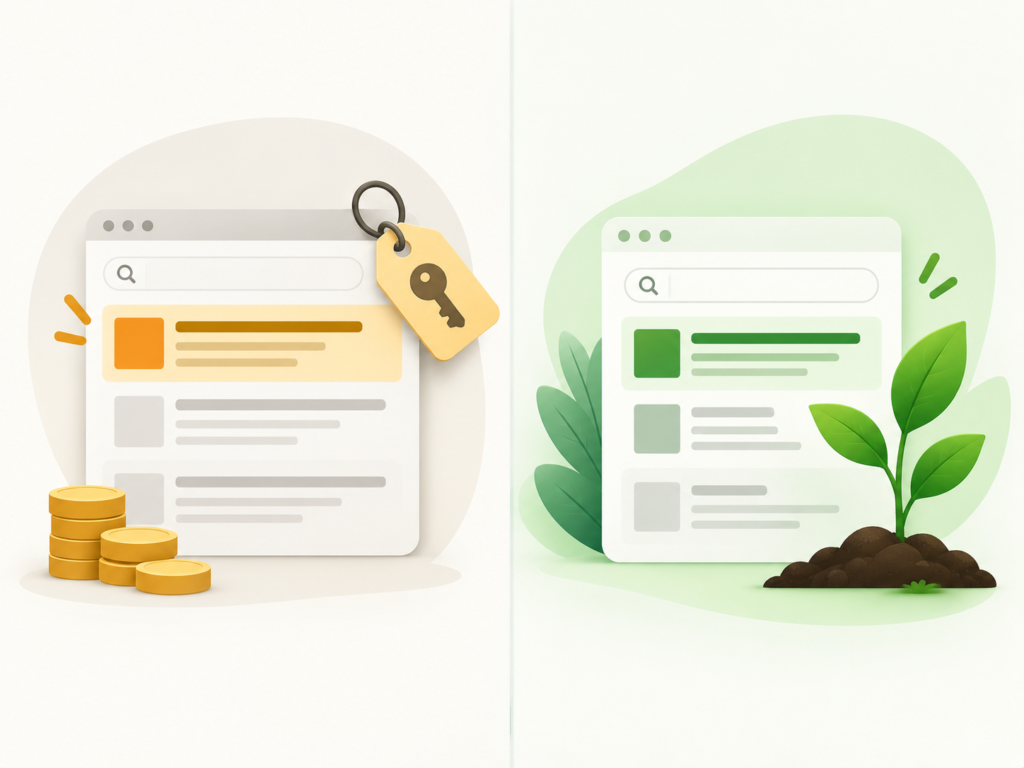
That distinction — rented visibility vs. owned asset — is really the core difference underneath the terminology.
A side-by-side comparison
| Digital Marketing (broad category) | Performance Marketing (subset) | |
|---|---|---|
| Scope | All marketing done through digital channels | Only pay-per-outcome advertising |
| Includes | SEO, content, email, organic social, paid ads, PR, influencer | Google Ads, Meta Ads, affiliate, programmatic, shopping ads |
| Payment structure | Varies — some free/organic, some paid | Pay for clicks, leads, or sales specifically |
| Results when spend stops | Organic channels often persist | Typically stops almost immediately |
| Primary measurement | Traffic, rankings, engagement, brand metrics, plus conversions | Cost per click, cost per acquisition, ROAS |
| Timeframe to results | Often slower to build (especially SEO) | Often faster, more immediate |
Why the distinction actually matters for budgeting
This isn’t just semantics — it changes how you should think about a marketing budget.
If someone tells you “we’re doing digital marketing,” that could mean almost anything: a blog that gets updated occasionally, a Facebook page that posts twice a week, an email newsletter, a small ad budget, or all of the above. It’s a category, not a plan.
If someone tells you “we’re doing performance marketing,” you should be able to ask a much more specific question immediately: what’s the cost per acquisition, and what’s the return on ad spend? If those numbers can’t be produced, something in the setup — usually the tracking — isn’t right, because measurability is the entire premise of the category.
This is also where a lot of small businesses get their budget allocation wrong. They put their entire budget into performance marketing because it feels safer — “I’m only paying for results” — without accounting for the fact that performance channels get more expensive as the market gets more competitive, and none of that spend builds anything that outlasts the campaign. Meanwhile, the organic side of digital marketing (SEO, content, email list-building) compounds slowly but keeps producing value without ongoing ad spend.
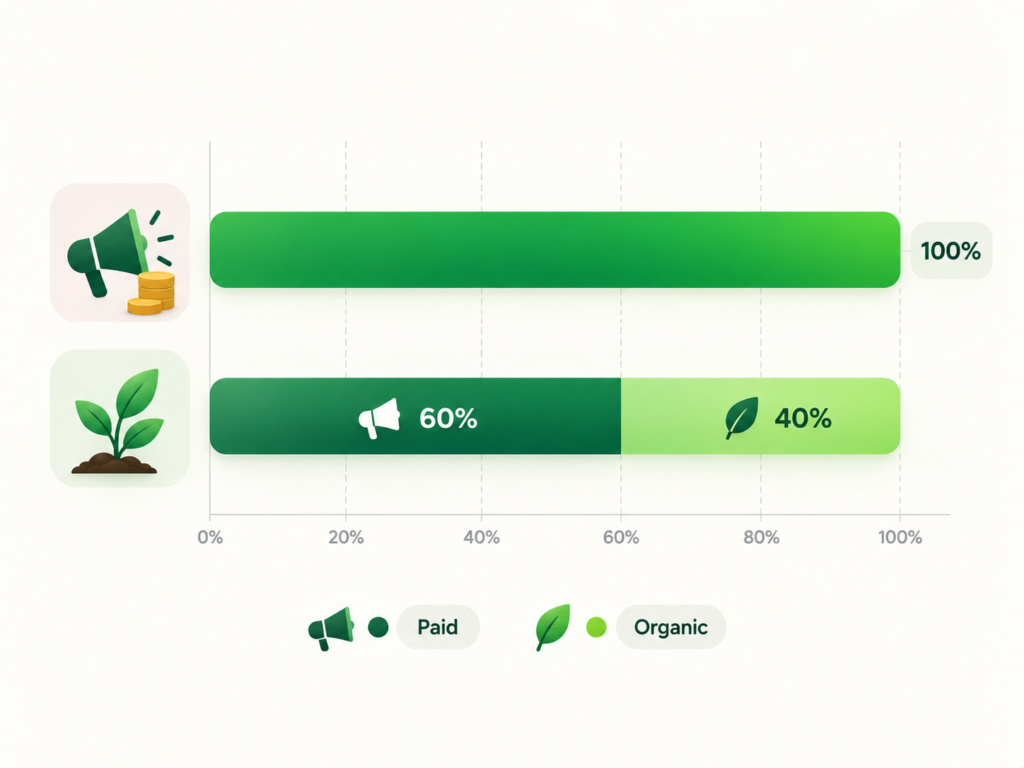
Hypothetical example: A local law firm spends $3,000/month entirely on Google Ads and generates 15 leads a month at $200 cost per lead. A comparable firm splits the same budget — $2,000 on Google Ads, $1,000 into building out SEO-focused content over six months. In month one, the second firm likely gets fewer total leads. By month eight, its organic content may be generating leads at effectively no incremental cost, while its paid spend is doing the same job the first firm’s entire budget was doing. This is a hypothetical illustration of a common pattern, not a guaranteed outcome — actual results depend heavily on competition, content quality, and industry.
Where the categories blend together
The line isn’t always clean, and pretending otherwise oversimplifies things.
SEO isn’t performance marketing in the strict sense — you don’t pay per click for organic rankings — but it’s almost always measured and planned using performance-marketing logic: cost per acquisition (factoring in the cost of content and optimization work), conversion rate, and ROI over time.
Email marketing sits in digital marketing generally, but a well-tracked email campaign with clear conversion attribution starts to look and get measured a lot like a performance channel, even though there’s no per-click payment involved.
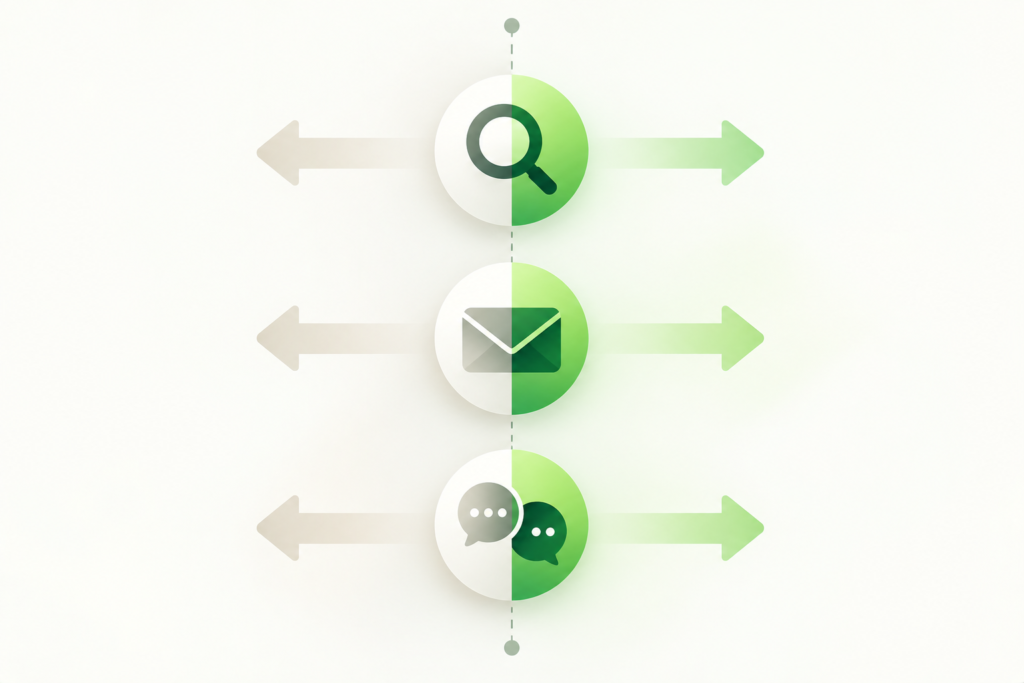
Organic social media is digital marketing, full stop — until you boost a post or run a paid campaign on the same platform, at which point that specific spend crosses into performance marketing.
The practical takeaway: don’t think of these as two separate departments. Think of digital marketing as the full toolkit, and performance marketing as the subset of tools where you can attach a precise dollar figure to the result.
How to decide where to put your budget
There’s no universal right split, but a few questions tend to clarify it fast:
- Do you need results in the next 30–60 days? Performance marketing is built for that. SEO and content marketing generally are not.
- Is your market highly competitive on paid channels? If cost-per-click in your industry is already high, building organic visibility may offer better long-term economics even if it’s slower.
- Do you have the infrastructure to measure performance marketing properly? Conversion tracking, a functioning website, and clear goal definitions matter more than the size of the budget. Without them, “performance” marketing isn’t actually measurable — it just looks like it is.
- Are you trying to build a durable asset or solve an immediate gap? Content and SEO build equity. Paid campaigns solve immediate volume needs. Most healthy marketing programs eventually need both.
Fokoro’s practical takeaway
When a business asks us whether they need “digital marketing” or “performance marketing,” we treat it as the wrong framing of the question. The better question is what specific business problem needs solving right now, and over what timeframe. A business that needs leads this month has a different answer than a business trying to reduce its long-term dependency on paid spend. We’d rather build a plan around that timeline than default to whichever term sounds more sophisticated in a proposal.
FAQ
Is performance marketing more effective than digital marketing?
That’s not really a fair comparison, since performance marketing is part of digital marketing, not a competing alternative. The real question is whether paid, trackable channels or organic channels fit your timeline and budget better right now.
Is SEO considered performance marketing?
Not in the strict definition, since there’s no per-click or per-action payment involved. But SEO results are commonly measured with the same performance-driven metrics, like cost per acquisition and conversion rate.
Which is cheaper: digital marketing or performance marketing?
Neither is inherently cheaper — they solve different problems. Performance marketing has a direct, ongoing cost per result. Organic digital marketing often has higher upfront investment (time or content production) but lower ongoing cost once it’s established.
Can a small business do performance marketing without a big budget?
Yes, but the budget needs to be large enough to generate enough data for the platform’s algorithms to optimize effectively, and enough to be statistically meaningful for your industry’s typical cost per click.
Does a company need a separate team for performance marketing vs digital marketing?
Not necessarily. Many agencies and in-house teams run both under one strategy, since decisions in one area (like SEO content) often inform the other (like which keywords to bid on).
How do I know if my current marketing is “digital marketing” or “performance marketing”?
Ask whether you’re paying per click, lead, or sale specifically. If yes, that portion is performance marketing. If you’re paying for time, content production, or a flat retainer with no per-action pricing, it falls under the broader digital marketing umbrella.